Pylant Springs History

As early as the 1870s, Pylant Springs served as a summer resort for pleasure seekers and patients alike as part of the renewed interest in water cures, or hydrotherapy. Therapeutic use of water dates back as early as 1000 B.C., and Hippocrates discussed these treatments in On Air, Waters, and Places, writing that “there are certain constitutions and diseases with which such waters agree when drunk.” Bathing has remained a staple of health and relaxation throughout the centuries, spreading across all cultures.
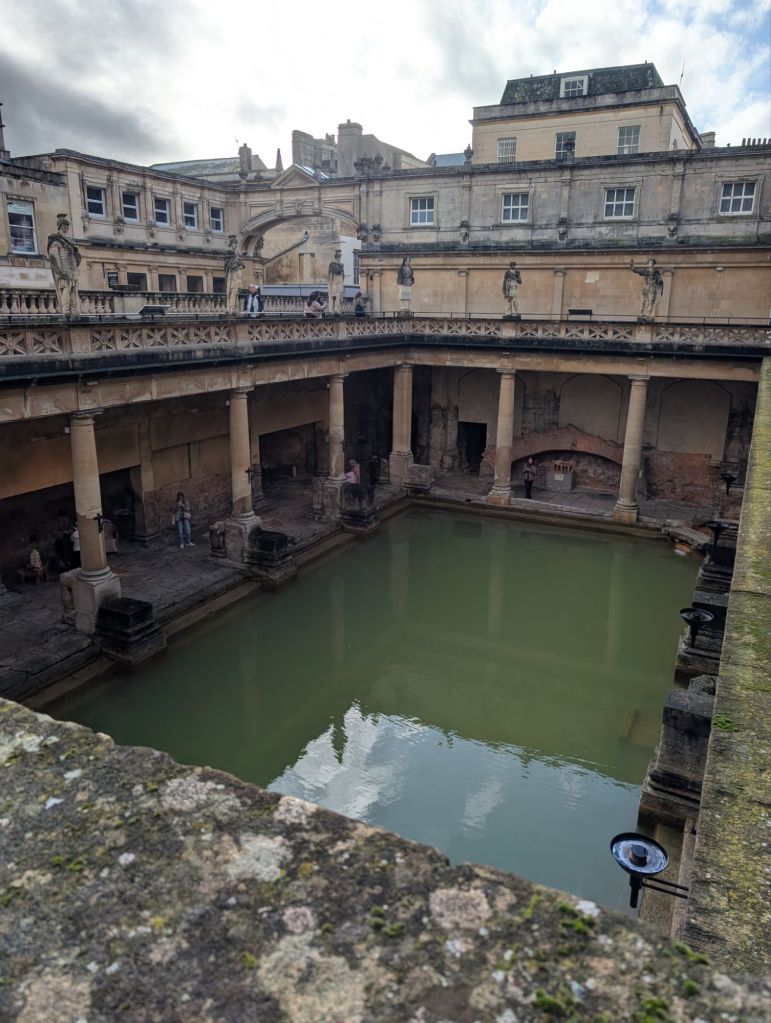
Waters at the Roman Baths in Bath, England.

In the 18th century, Empiricists who put emphasis on sensory experiences revitalized this idea, sparking a renewed interest in water treatment and resorts that focused on health and relaxation. Tennessee, with its plentiful natural water sources, was a perfect fit for this industry. The small town of Tullahoma, roughly 70 miles south of Nashville, quickly made a name for itself for Hurricane Springs and Pylant Springs, both famous for their “green water.”
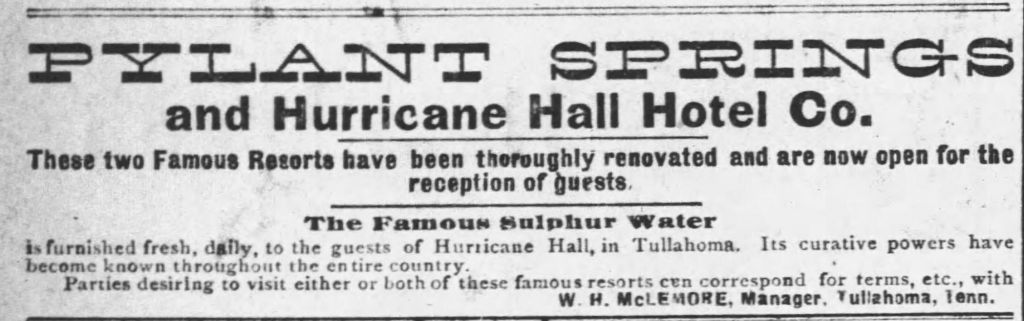
Chattanooga Daily Times, May 16, 1889

Pylant Springs was already an established summer resort by 1875, when the owners formed a Board of Directors to create improvements and management for the springs, according to a notice published in the Nashville Banner. It soon became a regular resort destination for Tennesseans, even hosting an 1883 reunion of soldiers who had served under the command of Gen. Nathan Bedford Forrest during the Civil War.

Visitors would arrive in Tullahoma via the Nashville, Chattanooga, & St. Louis Railroad. It was sixty-nine miles from Nashville towards Chattanooga. They would then take a hack (horse cart) to complete the six mile journey to Pylant Springs.
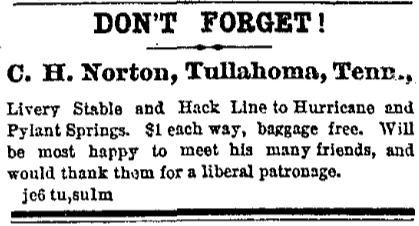
Daily American, July 4, 1882

Over the years, the property would be sold and transferred, and many would try to make new names to reignite interest in the property. Pylant Springs has been called Hurricane Springs No. 2, Cascade Springs, Mountain Falls Springs, and even Pilot Springs throughout the years — but more on that, later.

By 1883, Pylant Springs was well-established and could now host about 100 guests. An article in the Nashville Banner (advertising the resort as Cascade Springs) described the property as follows:

A meandering stream, fed by two mammoth free-stone springs of the clearest and coldest water, passes through the grounds. Follow this stream but a short distance, in sight of the hotel, and a most beautiful cascade comes into view, over which the crystal waters fall from the rocky cliff to a cove of picturesque grandeur. Further on another waterfall is seen, equally as attractive as the first. The glen or cove referred to seems to be rich in springs, and how many varieties will be discovered remains yet to be seen.

The two Tullahoma resorts of Hurricane and Pylant were linked in the early years, before the ownership changed hands and management split between the two. However, advertisements for one usually mentioned the other as a way to raise awareness, especially as the waters shared similar properties.  Briefly, in 1887, Pylant Springs became “Hurricane Springs No. 2.” According to an article in The Tennessean, monthly rates ranged from $25-55, weekly $10-15, and daily $2-2.50.
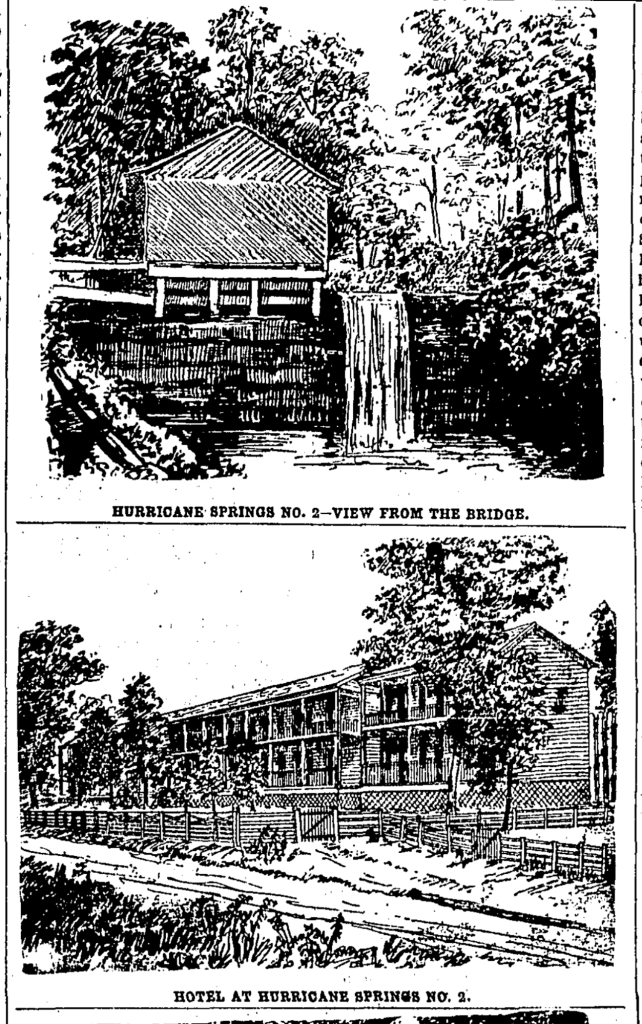
Illustrations from the 1887 article on the newly incorporated Tullahoma and Hurricane Springs Hotel Company.

In the late 1800s and early 1900s, newspapers regularly published the comings and goings of townspeople, as well as interesting tidbits. Visitors to Pylant Springs were often listed in the paper, as well as a few interesting stories. In 1883, an article in the Clarksville Weekly Chronicle described a young girl who was taken with a parrot she had seen at the resort. When trying to convince her father to buy her one, she argued: “You can teach it to curse.” An 1891 article described a man with impressive facial hair who lived on the Pylant Springs road: “His whiskers are full six feet long, and when combed out cover him completely.”

Advertising was essential when it came to managing summer resorts. Proprietors put classifieds in newspapers throughout the state, boasting of the healing properties and beautiful scenery of Pylant Springs. As an effort to build interest in the resort, an 1892 article created a mythology about the springs, claiming that soldiers in the Mexican-American war sought refuge there in 1847.
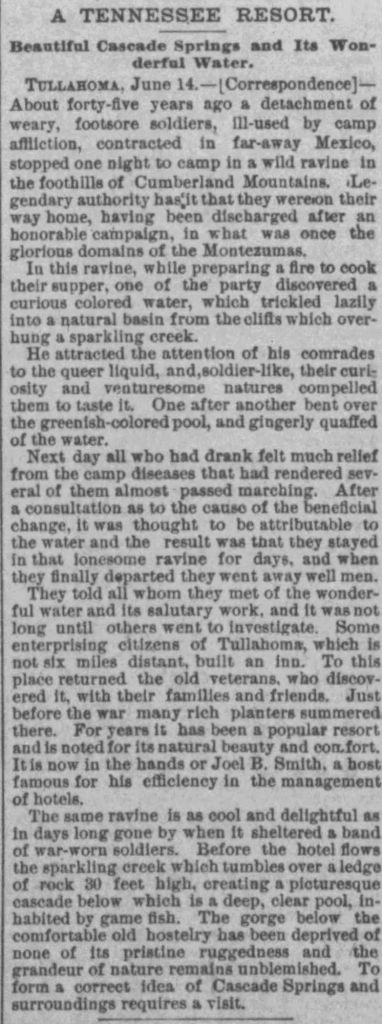
The Tennessean, May 15, 1892

Health claims for Pylant Spring focused on the “green water” found there. An 1897 article in The Nashville Banner claimed the water never failed to cure “that dread disease, gallstone.” The water was bottled and sold nationwide, but the advertisements assured people the best cure was only to be found in person at the resort. The source of the sulphur was the Black Devonian Shale abundant in the waters.

Mineral analysis of the water as published in the Nashville Banner, July 7, 1897.

In the late years of the 1890s, business at the resort slowed down. Allegedly there was a fire at the hotel in 1900, but a 1905 article mentioning the reopening makes no mention of this event. Leading the effort to reopen the resort was the Mountain Falls Spring Hotel Company, recently incorporated to run Pylant Springs (to be briefly renamed Mountain Falls Springs). The man in charge was named J. L. Valentino, a Nashville businessman already known for his successful chewing gum manufacturing.
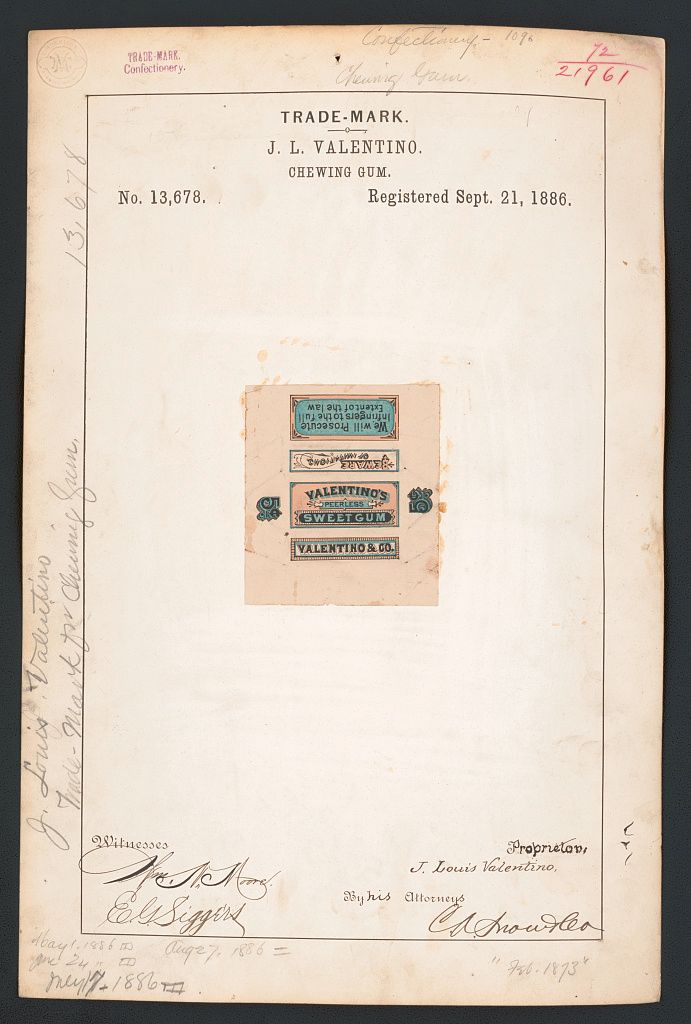
Trademark registration by J. L. Valentino for Valentino’s Peerless Sweet Gum brand Chewing Gum. Courtesy Library of Congress.

From 1905 to 1908, advertisements for Pylant Springs (briefly Mountain Falls Springs) were extensive. Multiple long articles celebrated the resort’s beautiful scenery, hotel accomodations (now with toilets!), and healing waters. Improvements were extensive, with apparently a new lake planned for fishing. Roads allowed for easier travel between Pylant Springs and Tullahoma, meaning it became easier for guests to arrive at the resort.
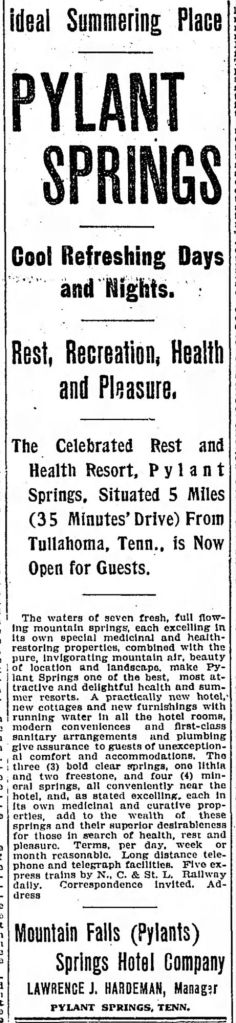
The Tennessean, July 1, 1906

Unfortunately, the ease of travel with automobiles did not necessarily lead to continued success at resorts such as these. As infrastructure improved, people had the ability to travel to more destinations than ever before. It was difficult for an aging resort in a small town to keep up with the accommodations offered at other places like Lookout Mountain in Chattanooga, for example.

Pylant Springs was a seasonal resort, usually only operating in the summer. When the hotel burned down in August 1925, only the caretaker and his family were on the property. The hotel was never rebuilt.

Pylant Springs is located in the community of Awalt, also known as Mash Bread in its early years. This area was well-known for its moonshining business:

“[T]he springs of Awalt also provided the ideal spot for the construction of whiskey stills. At one time, Awalt was noted for the moonshines. During the 1920s ‘illegal liquor’ was made in almost every hollow around the community and it seemed to be the major industry of Awalt.”

– Anna Trawick, Awalt: A Nostalgic Memory and Farewell, p. 9. from the Franklin County Historical Review, Vol I, No. 2

The demand for moonshine skyrocketed during the Prohibition period following the 18th amendment passed in 1919. Moonshine requires fresh spring water, and with the resort no longer on the property, Pylant Springs with its plentiful green water was an appealing site for moonshiners. It’s unknown how much moonshine was manufactured there, but in 1948, a man was shot during a raid on an illicit distillery in Pylant Springs.
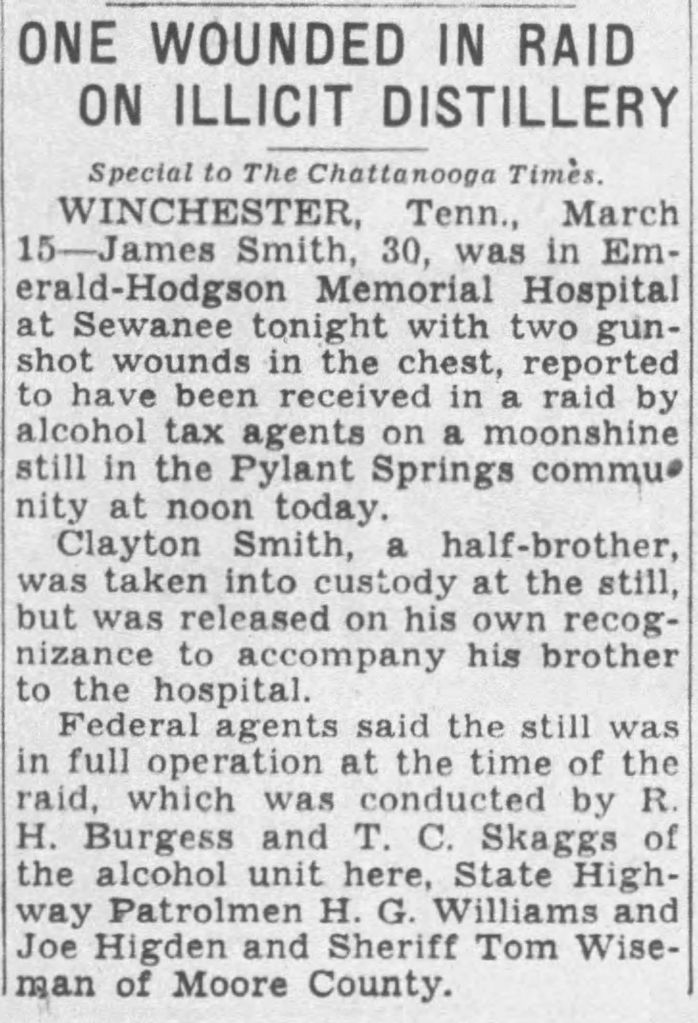
Chattanooga Daily Times, March 16, 1948

40 years after the hotel burned, there weren’t many people who remembered spending summers at the resort in Pylant Springs. In fact, a decades-long game of telephone meant that the community was instead remembered as Pilot Springs. In the 1960s, a hunting game preserve was established on the property. For $20 a day, hunters could come to Pilot Springs and hunt pheasant, quail, and partridges. A hunting lodge was eventually built to serve as accomodations.
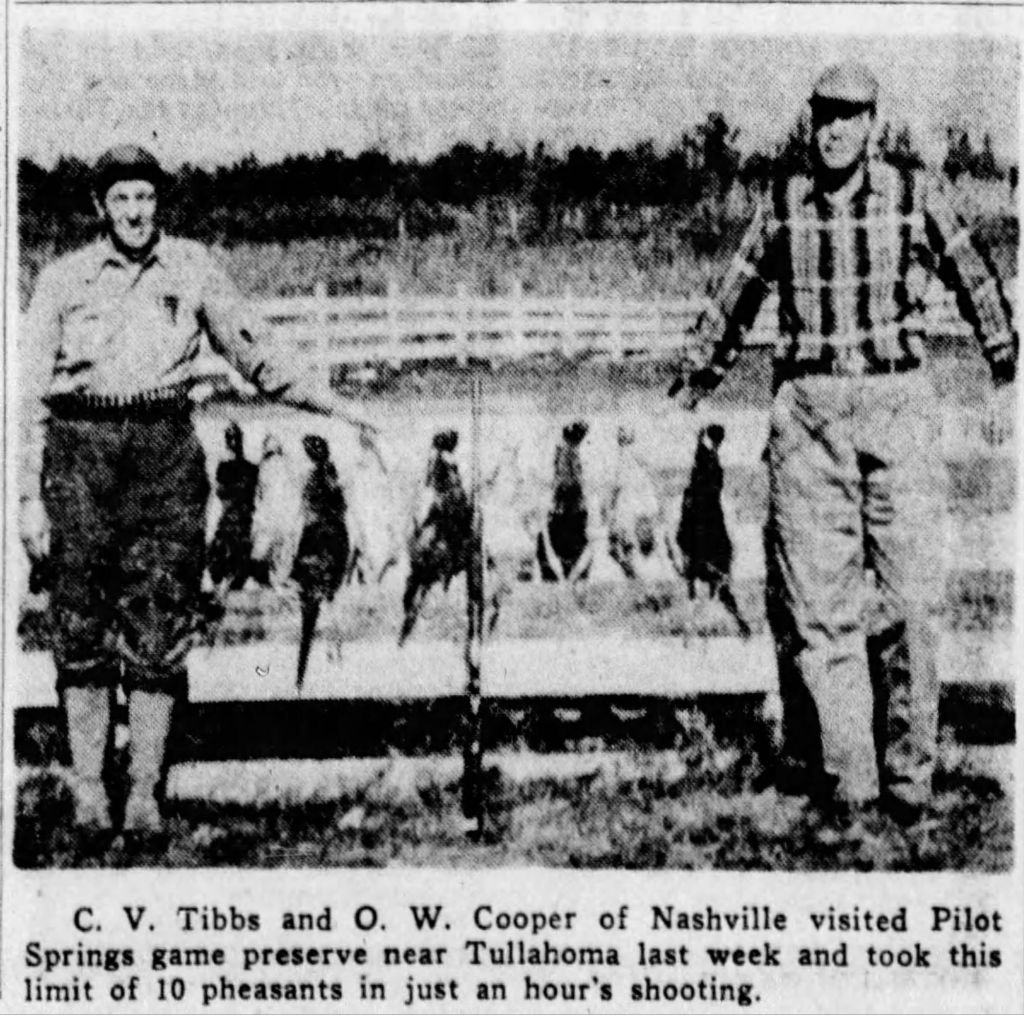
The Tennessean, December 18, 1960

It’s unclear how long the hunting lodge remained open. Over the decades, whatever property remained at Pylant Springs became a hazard and was eventually torn down. Occasionally, one might find remnants of the old sites in the waters that flow through the property, such as old hotel keys, dishware, and even brickwork.

Brick work remaining from the Spring House to the left of the waterfall.

In the 1990s, the property was purchased by a local doctor who built his home there. It remains a pleasant oasis and refuge from the busy life of the city. Its beautiful spring water remains a source of good health — even if it doesn’t necessarily cure an extensive list of diseases as once claimed in the 19th century.
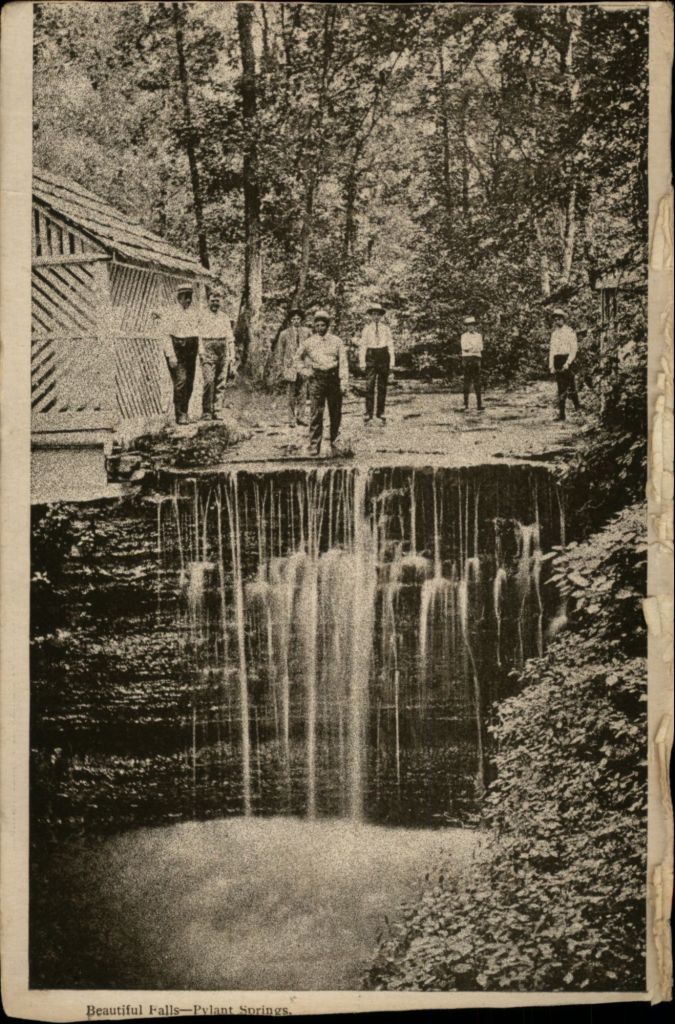

Pylant Springs postcard, ca. 1890s
The falls as seen today.

There’s but one Pylant Springs on earth – it’s the only water that cures.

– 1905 advertisement in The Tennesseean
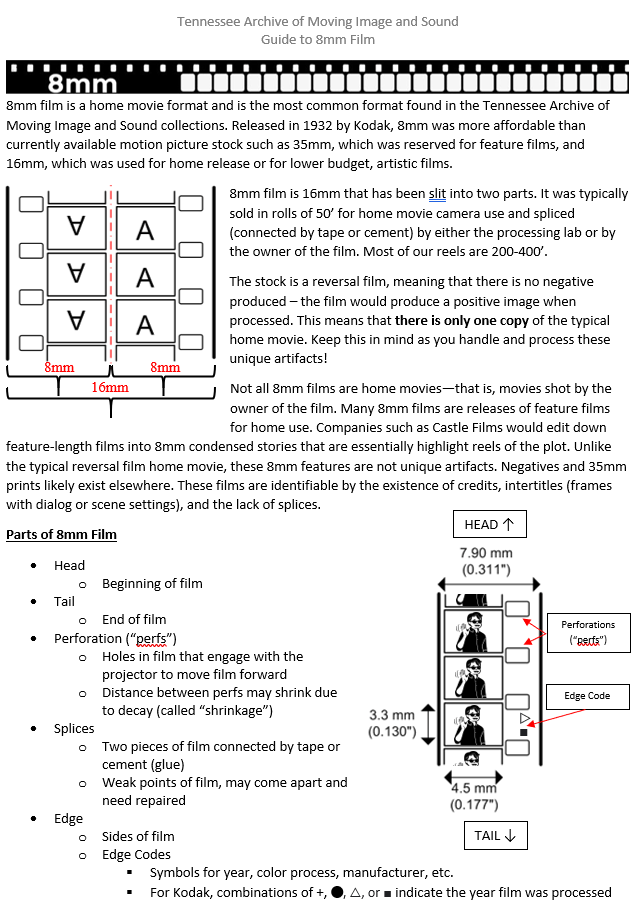
Reference Sheet for 8mm Film

I created this resource for as a quick introduction to 8mm film for a practicum student who was new to handling film. Feel free to use and edit this document however you see fit, including retooling it for different formats. I only wanted it to be one page, so I did not include other important information such as identifying base and emulsion.

8mm Reference Sheet created June 2022 and released under a Attribution-ShareAlike 4.0 International (CC BY-SA 4.0).

Image Credits:

28mm at the NFSA

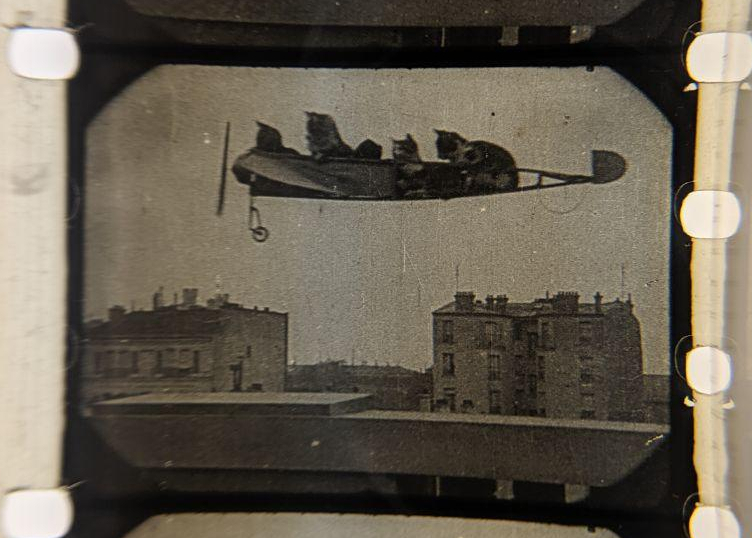
Les Chats (1910)

During my fellowship at the National Film and Sound Archive of Australia, I inspected a large collection of 28mm films. Using my research skills, I identified several unknown titles within the collection and helped identify unique Australian films. As a part of my fellowship, I wrote a blog post about the experience:

Many of the films that I inspected were almost 100 years old, but they were all in surprisingly good condition. However, film damage and decay is not uncommon with this format. The film conservation experts at the NFSA were able to teach me new conservation methods to deal with issues that can damage these films or make handling them difficult.

As 28mm was used as a home movie format, it was especially important that it not catch fire easily. Naphthalene, a fire-retardant chemical, helped make the 28mm diacetate film safer. As these films age, however, the chemical releases and can be hazardous to inhale, so archivists must take precautions to limit their exposure.

Read more about my experience and see some examples of 28mm by reading the blog at the  NFSA website. 

Nancy Mysel Legacy Grant

In 2019, I was selected as the recipient for the Nancy Mysel Legacy Grant for film preservation from the Film Noir Foundation. It was an absolute honor to receive this award to continue my studies at the L. Jeffrey Selznick School for Film Preservation. You can learn more about Nancy Mysel’s work and the grant named for her at the Film Noir Foundation’s website.

For my application, I wrote an essay about my passion for film preservation:

I aim not just to restore films and movies in digital representations. My desire is to uphold the creativity and innovation of filmmakers. The clicks of the camera, the whir of the film, the hum of the projector bulb — this is the artistry of film. This is what will ensure its survival and what can be brought to the public in a palpable way. Projection in a cinema brings life to the film that is often lost in a digital form; appreciating the power of film is integral to understanding the importance of film restoration and preservation. Film’s impact on the cinematic experience is why I am proud to be the odd one out in my class.

As a thank-you to the Film Noir Foundation, I created a video that was screened at Noir City in February 2019. You can watch that video by clicking on this link.

Thanks to the support from the Film Noir Foundation, I am able to continue my studies at The L. Jeffrey Selznick School of Film Preservation and finish my project on decaying acetate film affected by vinegar syndrome.

Smithsonian Folklife Festival Audio Documentation

In Summer of 2016, I worked as an intern audio archivist at the Smithsonian Center for Folklife and Cultural Heritage. It was an absolutely wonderful experience where I learned invaluable skills that will definitely shape my career as an audiovisual archivist.

One of the major projects I worked on during my internship was the 2016 Smithsonian Folklife Festival. As an intern audio archivist, I worked to create audio documentation for the festival to ensure that recordings of stage performances will be available for future researchers and historians. Here are some infographics I created using Adobe Photoshop and other design tools:

improvedinfographic
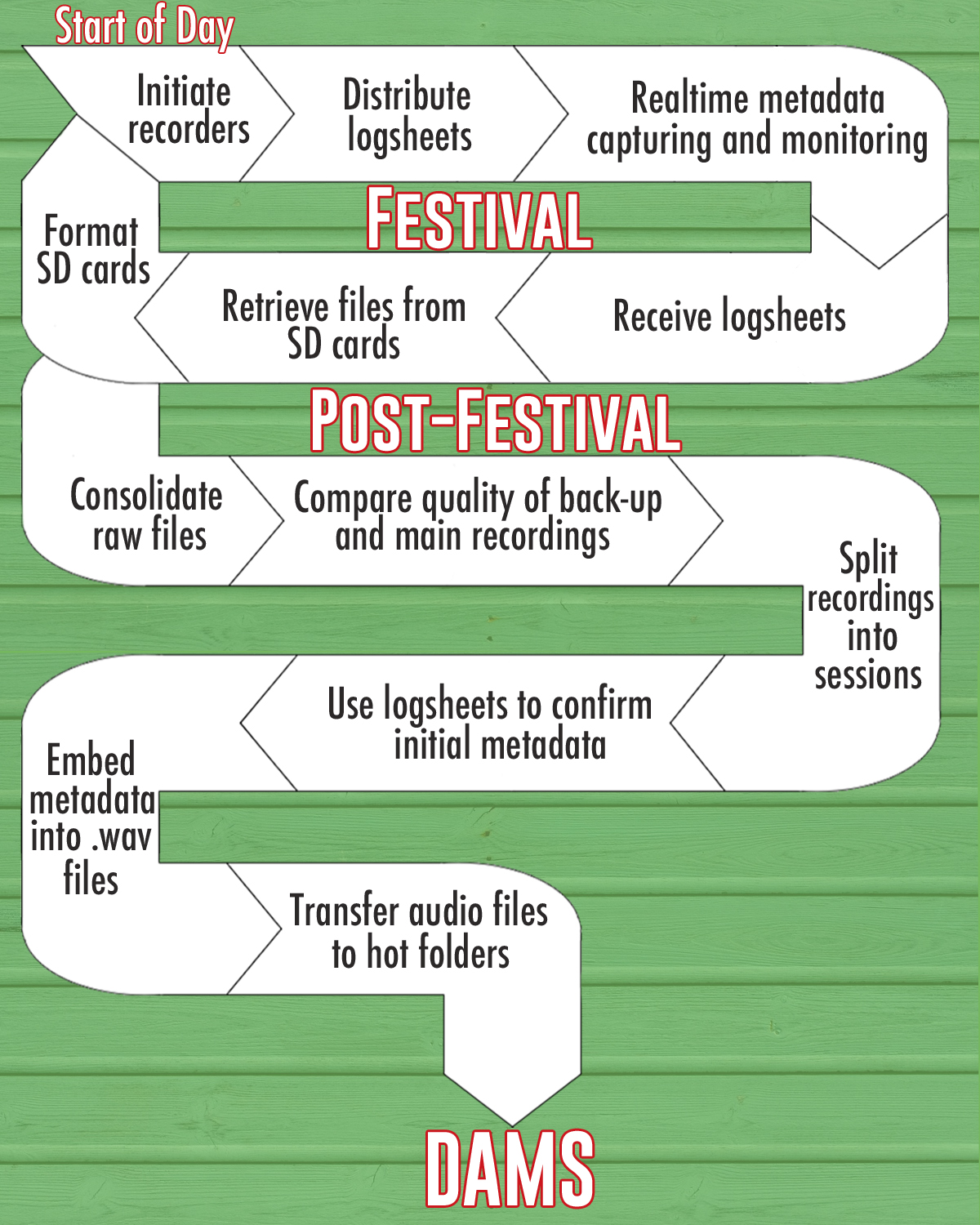
Workflow for audio recordings at the festival. This graph shows how documentation moves from the festival to the Digital Asset Management System.

The above infographic gives a step-by-step explanation of the documentation process. As you can see, there are several steps taken both during the festival and afterwards to ensure a better experience. In fact, all of the audio documentation for the festival was ingested to the DAMS midway through August 2016–a little after a month after the festival.

Volunteers are integral to the audio documentation process. At each stage, they are given logsheets to write down important metadata such as the names of performers, individual song titles, and themes, as well as any changes to the schedule or technical difficulties. We confirm the metadata and then embed it into the individual session files using BWF MetaEdit.

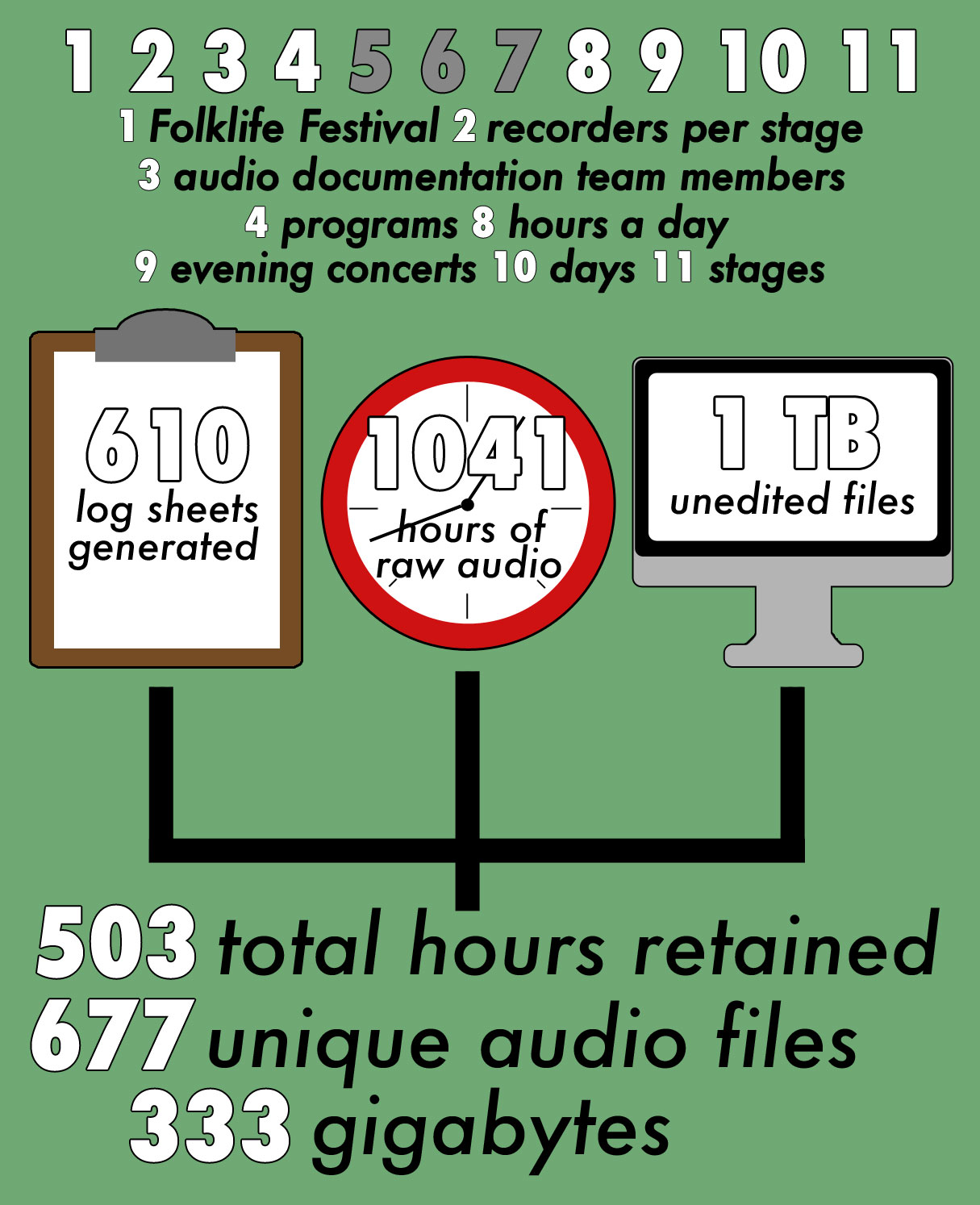
To show just how voluminous this project was, I created an additional statistical infographic:

bythenumbers
The quality control work of comparing recording qualities meant that we were able to refine what materials we would keep as archival based on our standards. 

These materials will be used to train future volunteers and interns as well as accompany presentations on the audio documentation workflow for the Festival.

Community Trust and Crowdfunding

Note: This post originally appeared on my blog for the course Social Informatics.


Everyone knows a little something about crowdfunding – remember that weird potato salad Kickstarter that went viral? – but I didn’t know much about it in terms of professional libraries. Let’s dig in…

crowdfunding
Throw money at an idea until it works! Seems simple enough. (Retrieved from http://www.edisonawards.com/news/crowdfunding)

In her article “Crowdfunding: What’s In It For Us Librarians?,” Hope Leman writes about how libraries can use crowdfunding as a tool to involve their community and build a good reputation. She speaks about projects she’s crowdfunded and how the site works in general, and then delves into library projects funded on Kickstarter by outlining their themes and how successful they were. She takes examples of projects she’s funded for libraries and suggests that they need to rewrite their content so it captures the attention of potential donors. To conclude her paper, she writes:

The age of crowdfunding is upon us, and opportunities abound for savvy librarians and information scientists. There are risks—if you fail, you fail publicly, and your Kickstarter page stays up whether you make your goal or not. Moreover, it takes time to develop and market a crowdfunding campaign. Nevertheless, a well-conducted, successful campaign could generate goodwill in your community and convey the image that your library is a with-it, happening place.

Leman urges libraries to consider crowdfunding as an option for future projects. So, let’s consider it, shall we?

Argument: Libraries should use crowd-funding. 

Support: Successfully funded library projects that built community interest.

In Leman’s paper, she discusses a few library projects that caught her attention as a Kickstarter backer. LibraryBox 2.0 was her main example of a successful Kickstarter. Jason Giffey had an initial goal of 3,000 and was overfunded to a total of $33,139. Two years later, LibraryBox goes on sale for $150. All in all, it was a very successful Kickstarter that was met with praise. Best of all, Jason Giffey was a librarian. This is doable for library professionals, and he proved it.

Libraries often face budget cuts. All library professional knows this. The Huffington Post even has a tag dedicated to it. For many public libraries, it’s all they can do to stay open and keep books in circulation. If they have an idea for a project that can keep the community involved – like the Literary Lots project to engage children in Cleveland – they may not have enough money in their budget to do so. Turning to the community, then, is a great idea.

Community outreach for funding is perfect if your project serves the community. You can’t create a Kickstarter for, say, a new coffee machine in your office. But if you have an idea for something that could turn more interest to your organization in your community, then crowdfunding would be an effective way to do so. You would build trust in your community by following up on your promises as well as showing initiative to create new projects.

Counter-Argument: Libraries should use more private means of funding. 

Support: A multitude of failed projects that have caused backlash. 

Despite the success of the LibraryBox 2.0 Kickstarter, Jason Griffey still faced a multitude of issues. When his project grew closer to its goal, funders began to pull their pledges, assuming that he no longer needed their money. She even quotes a tweet of his where he admits that the real “secret” to pulling off a successful Kickstarter is to have a multitude of connections. According to his site, the success of LibraryBox 2.0 is thanks to both Kickstarter and a grant from the Knight Foundation.

If you’re considering launching a public crowdfunding campaign, you need to already have a good social media presence. Unfortunately, not many libraries have adjusted to social media in a way that goes beyond an informative tweet once a week. Though this is better than no presence at all, it’s not often engaging for the community. If you want your community to donate money to your cause, you need to to know that you can count on people rallying behind your organization.

Let’s say you do think you have a good potential donor pool. That’s great! But you need to really understand how much money your project will need. This is true for any money request, especially professional grants (you’ll probably get turned down if you haven’t outlined your expenses clearly). Grant foundations often understand that estimates can sometimes be inaccurate. Kickstarter backers, however, might not be so forgiving.

Consider that a Kickstarter does not just require getting the money raised. You need the money for the project, plus money for the incentives that you will ship to donors. I have seen several successfully-funded Kickstarters that then failed fantastically. The people who donated to the project begin to lose faith in their company, and will take to Twitter and Facebook to openly complain about not receiving their promised rewards. Examples of Kickstarters that failed in this way include The Coolest Cooler, Yogscast, Leelah ProjectGeode from iCache, and many others.

Almost all crowdfunding sites require that you provide some level of rewards. Not only do you need an itemized list of how the money you raise will successfully shape your project, you also need to set aside money for rewards. These rewards should be inventive. For example, if you were going to raise money to create a local film archives, then you might offer someone who donated $100 a chance to get their films digitized, or perhaps someone who donated $50 could attend a donor’s dinner. Rewards can add up quickly – the Mystery Science Theater 3000 Kickstarter had 27% of their goal dedicated to the costs of shipping and creating rewards.

If you don’t have all the estimates down, then you might end up with a funded project that only barely covers the cost of your actual goals – or maybe doesn’t cover it at all. First, you need to send out the rewards as soon as possible, and then see what you have left. If you don’t, then backers will get angry, and will label you as a scam. They are not very forgiving. Using a more private means of getting funded – like a grant – is a near guarantee that people will not label your organization as a failure or as incompetent. This is very important. You need to consider how your organization would handle a failed Kickstarter, and how you would deal with the backlash.

Discussion

Any project proposal that requires IT can get messy. In class last week, we discussed the failure rate of government IT Projects. Only 5% of large federal IT Projects in the last decade fully succeeded. 41% were complete failures that canceled before they were even turned on. This is the government we’re talking about. They have much more money for their projects than most libraries will get for their crowdfunded projects. However, they only have themselves to answer to. If you use crowdfunding, you might have a large community turn your backs on you.

Crowdfunding, if successful, can strengthen your ties to your community. It’s worth considering if you believe that your project is something that people are interested in and would be willing to support. However, if you’re not absolutely sure about how to complete a project goal, then it might be better to turn to other sources.

Information Accessibility & Upward Mobility

Note: This post originally appeared on my blog for the course Social Informatics.


upwardmobility
The idea that people can “climb the ladder to success” often ignores that the ones on top make it difficult to follow them. (Image from: http://www.economist.com/news/leaders/21571417-how-prevent-virtuous-meritocracy-entrenching-itself-top-repairing-rungs)

Technology can save the world! Can’t it?

The idea that technology is able to drastically change economical circumstances around the world is the running theme throughout the required readings for today. Many of these readings reek of White Savior complexes, especially the start-ups mentioned in Charles Kenny’s “Can Silicon Valley Save the World?” article. Charles Kenny writes of several start-ups meant to ‘fix’ impoverished countries, all of which began with the idea that a simple invention can solve the problems of entire countries. He speaks of a claim made by broadband companies that access is linked to an increase in GDP, outright ignoring the fact that China has many impoverished citizens while also having some of the most ubiquitous broadband access in the world. Another great point that he makes is that accessibility to the internet means nothing in countries like Liberia where the literacy rate is very low.

Some most egregious examples of failed western inventions meant to fix poverty abroad include a soccer light ball called “Soccket” that costs 10 times more than an effective solar-powered lamp while also requiring the ball to be played with before the light will work (because, you know, all African children love soccer and need to play more than they just need working lights). PlayPumps, a water pump backed by influentials like AOL and Laura Bush, cost four times what a regular working water pump does. It was also prone to breaking and required 27 hours of “play time” in order to meet the water needs of the community. Because, again, African children love to play, more than they love accessibility to water.

I’m digressing here. I suppose this desperate need that (mostly white) westerners feel to fix the rest of the world doesn’t sit well with me, especially since we so often ignore that most of the structural issues within these countries come from our direct involvement in these countries via colonialism. (See: “How Europe Underdeveloped Africa” by Walter Rodney. I’ll even give you a link to a pdf! Click.)

Of course, my initial cynicism and distrust does not do well to comment on how technology has served to help improve society around the world. In Kenny’s article, he lists many successful companies that have helped countries via accessible medicine.

The very idea of social informatics is that society affects technology and vice versa. Consider the political cartoon at the beginning of this article. American culture pushes this idea that disenfranchised citizens can become successful, when truthfully the wealthiest only seem to get wealthier as the poor become poorer. This economic divide, and its continuing widening, is reflected within information science. The digital divide, as defined in the Kerry Dobransky article as “a gap […] within and between societies in the degree to which different groups have access to and use information and communications technologies,” widens as technology helps facilitate communication.

Consider the situations in Africa I referenced with Liberia’s failing literacy rate. Kenny described a push to give laptops to African children, despite evidence that shows laptops do not significantly further education. What good is a laptop if children can’t read? What good is accessibility to this technology – when gifted – if literacy isn’t accessible as well? Technology, though it has given us unprecedented access to information, causes this gap to widen. Poor, uneducated people do not have access to the technology nor the ability to use it, while the wealthy and educated gain more and more knowledge and benefit from these technologies at skyrocketing rates.

Of course, there is another side to this argument, as there always is. Sure, giving technology blindly does not solve poverty just as putting a bandaid on a broken dam would not stop a flood. However, reasonable expectations can be met by making information technology more accessible to disenfranchised persons. Consider public libraries – they strive to meet the needs of even the poorest of the community. My father, who grew up in poor, rural Mississippi, told me that he would spend hours reading books at the library on any subject he could get his hands on – and today he’s a successful orthopedic surgeon.

Yes, rich people do benefit from information technology at rates much higher than poor people. However, this does not mean that this technology is at all wasted on disenfranchised members of the community. It can still help them. It is when people have extremely high expectations of technology when it does less to help and more to hurt a community. If you make exorbitant claims that a iPhone app is going to solve world hunger, then of course your app will fail. Technology can help. We just need to be realistic about it.

Evolve or Die: The Necessity of Innovation

Note: This post originally appeared on my blog for the course Social Informatics.

I’ll have to admit that the idea of innovation is not something that interests me. I have never been suited for business and I am not the type of person who goes about trying to change things. I am stubborn, unable to move in my old ways (probably why I became an archivist–just kidding!). Of course, I will try out new and improved ways of doing things. But I am not creative in that way; I will not be the one doing the innovation.

The concept of innovation, therefore, is somewhat daunting. I think of imposing businessmen at long tables with a stammering, hopeful innovator standing at one end, about to pitch a new idea. It’s never appealed to me, which is precisely why I’ve never pursued any sort of business venture: it’s simply not for me.

However, all of this week’s readings revolve around innovation. For a while, I tried to see if there was a subject I could cherrypick from these articles in the hopes I wouldn’t have to pursue the idea of innovation as a blog post. Alas, this was not the case, and I am stuck here with a little imp called innovation jeering at me while I stare blankly at these pages.

My cautious approach to innovation is the idea of evolving in order to adapt to a increasingly technological society. After much consideration, I have smashed “innovation” and “library science” into one argument: a library must evolve to survive, or it will surely perish.

stein-library
A political cartoon about libraries from 1996. That’s 20 (!) years ago. (Retrieved from: http://edsteinink.com/2009/05/08/oldie-but-goodie/)

The modern teenager would have you believe that libraries are not useful anymore. After all, with a simple Google search, you can find all the information for a research paper you need, right? A visit to Wikipedia, and blammo, you’re done!

Wow, it’s so simple. I really wish someone had taught me that in undergrad! And here I was, spending hours vetting articles through JSTOR, Muse, or EBSCO. So silly–everyone knows that no one can lie on the internet.

Let’s take a little side trip here to show you a humorous example of lying on the internet, from this very amusing Tumblr post. According to this post, Tumblr user hullaballoons created a website about 6 years prior with falsified “facts” about President James Buchanan. Though it was not an official site whatsoever, many misguided and eager Googlers typed in “james buchanan facts” and stumbled across her site. It wasn’t just shared on social media; an author of a presidential trivia book took these entirely untrue statements as fact and published them.

Because, of course, nothing on the Internet can be a lie. You have to be qualified to post here. (Just don’t look at a comment section on YouTube anytime soon.)

Of course, anyone with any sense in their brains knows that there is a lot of false information floating out there on the Internet. If you were to browse books in a library on a certain subject, you can be sure that, most of the time, the books therein contain accurate information that you could use for a paper or presentation. But as more students procrastinate, few want to browse the bookshelves when they believe the Internet can give them the instant answers they need.

So librarians adapt. We give lectures to classes of incoming Freshman on how to search for accurate information. After all, that’s a major part our job – to be able to search for information for patrons so that their research needs are fulfilled. So, when they’re either too pressed for time or too nervous to approach us, we take the process to them. I remember I often hated sitting in those lectures during early English or History courses where a librarian would show us how to use a database, but I know that if I hadn’t known those search methods, there were many papers I would have never finished on time.

There are many who agree that library outreach is a necessary innovation. In an article on Public Libraries Online, Carolyn Anthony asserts that libraries must remain relevant by adapting to modern user’s needs:

Accepting the need for constant innovation will require that public libraries adopt a disciplined approach to turning outward toward the community to understand how the library can adapt to people’s changing lifestyles and patterns. It will also require that public libraries hire people who are creative, analytical, and social to engage with community residents, and to form partnerships with agencies staffed with workers having diverse skills who can work with us to help the community achieve its aspirations.

A cornerstone of library science theory is that libraries exist to suit users’ needs. What use is a library that sits pretty but isn’t accessible or worthwhile? Though it is an important repository for human knowledge, it also serves a greater purpose. When our users’ needs changes, so must our methods.

Perhaps the idea that libraries are outdated and backwards is a public relations issue. In an article on Shareable, Cat Johnson insists that libraries are evolving–and have been for quite some time. Within it, she cites evidence that librarians have embraced Internet since its widespread use, and it certainly makes sense once you stop to think about it. As information science professionals, why wouldn’t librarians learn to use online resources? For some reason, however, librarians have this bad rap of being obsessed with print and stuck in their old ways.

It’s hard to find any literature that argues against libraries, believe it or not. I was sure that I might find some sort of ultra-conservative rant about libraries being a waste of taxpayer money, but I was pressed to find such arguments. Instead, I found several rewarding arguments that posed the question, “Do we need libraries?” answered with resounding “YES!”s all around. Until, that is, I found one simple blog post from 21st Century Library:

. . . There is no adequate answer – yet.

Why is that? Why are we – the profession – unable to answer that fundamental question? Is it because there is no single answer that satisfies everyone? Is it because the answer is too big for non-librarians to understand? Is it because it is the wrong question that has no correct answer? Yes. Yes. and Absolutely!

When we look at what the library is evolving into today – the 21st Century Library – we can easily answer the “Why…?” question with a “We don’t.” answer. BECAUSE that tired old question is asking why we need the “classic” library, the 19th Century Library, the “collection of books” library, the librarian as “gate keeper” library. And the correct answer is WE DON’T!

We absolutely DO NOT need that tired old stereotype library with the bunned, shushing librarian guarding a dusty collection of “books.” Society has no use for those obsolete libraries and librarians of the past that were adequate for the society of the past.

I won’t share the entire post, though it’s certainly worth a read. Kimberly Matthews’s post cries out for a call to arms for libraries to adapt to the 21st century–and for users to see that libraries have embraced modern technology. Though the librarian stereotype of an old, angry woman “shushing” a patron from behind a stack of dusty books may ever prevail, we never need to stoop so low as to fulfill that social prophecy.

Libraries are better than that. Our users DESERVE better than that. And that is why innovation is an essential part of the future of library science.